
Reflections on the Odyssey

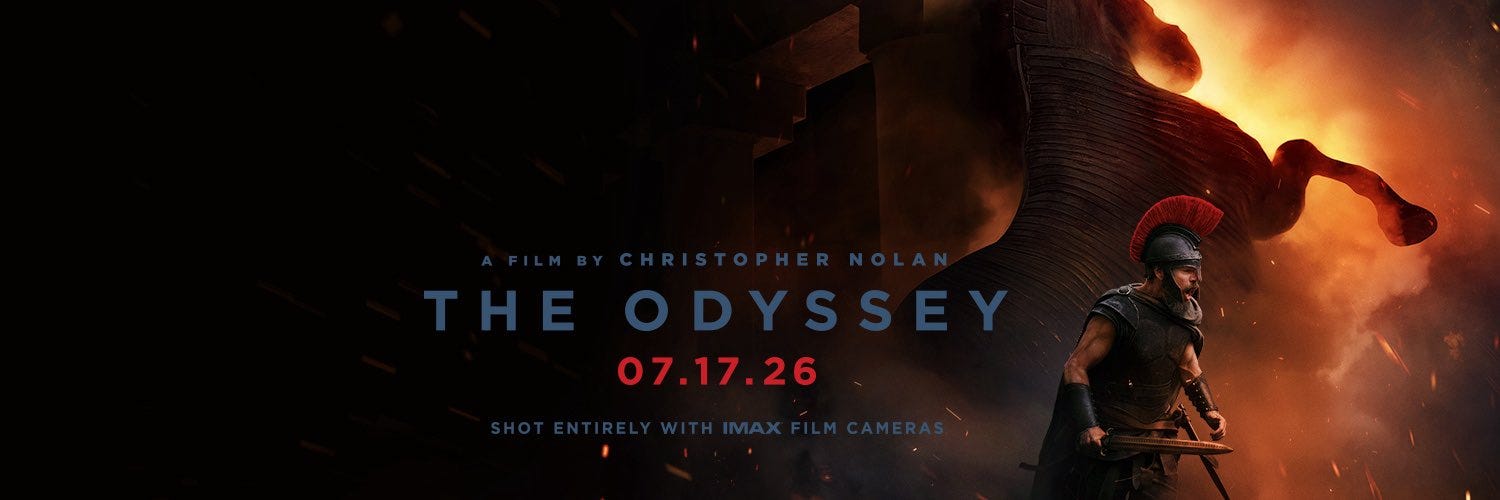
I liked it. It seemed that connections to Christianity were around every corner. From a story written well before Christ. A time when the hearts of men were being prepared, and perhaps still are, through our own respective Odysseys for reconciliation.
Below are some themes outlining the ties between Catholicism and this strange world of Greek poetry. Poetry that may unintentionally be more accurate than it set out to be when understood through the light of revelation.
Man’s Search for Reconciliation
The Odyssey tells the story of man’s search for home. Simple on the surface. Though one which painfully reveals his inability to arrive, always one island away.
The Christian also embarks on a pilgrimage, in search of his God, torn by the effects of the fall. Leaving him in both a state of exile and one of becoming.
St. Ignatius describes the spiritual life as that of a pilgrimage. Emphasizing holy detachment. That this life is ultimately ordered towards the next. Even the greatest of consolations we experience are something less than what our hearts are ordered towards.
Therefore, similar to Odysseus, we too must carry on.
“Foxes have dens and birds of the sky have nests, but the Son of Man has nowhere to rest his head.” - The Gospel of Luke
The Question of Hope
Odysseus’ heart was stirred by hope. Yet, his hope was in the abstract. The home he sailed towards had already changed and so had he. His curse was to never arrive. Even after reuniting with his wife, he headed east. Onwards to the next land.
Hope for the Christian is much more concrete. It is one of the great gifts of God.
Pure hope, in God, is the only hope which never fails. Since this hope is of God: a theological virtue. To hope in God is to mysteriously arrive at the destination of God. By rediscovering this hope we find that God has never left us. Rather has destined us to arrive at life with him.
Hope is the answer to the question of free will and predestination. Insofar as we choose to hope uprightly we are by proxy destined to God’s life.
This hope can be discovered on the brink of despair. When according to the world there is no cause for it; yet, the soul is elevated to carry on distinguished by an angelic clarity which is unmistakably of God. It is given to us in baptism and fueled through sacramental life and prayer.
So, the christian can carry forward on his Odyssey with the confidence that he has already arrived. He can sail the seas without needing to cast himself adrift in an endless search for an elusive home. He can let the world as it is, rife with brokenness and beauty alike, inform this privileged life within him.
“If we hope in God by hope we already possess him. Since hope is a confidence which he creates in our souls as secret evidence that he has taken possession of us. So the soul that hopes in God already belongs to him.” - Thomas Merton
The Holy Spirit
Jordan Peterson says it well, “just try and avoid your conscience and see what happens”. This effect of God within us is not neutral. It stirs us to act for what is good, even at great cost to our worldly life.
Odysseus had it all, on the island with Calypso. Yet, something within him pulled him onwards, away from the flesh, onto a raft, adrift in the ocean.
A christian may relate to similar movements in their heart. Inspiring them to defy natural desires. A real death of sorts, turning from what is not of God despite its luminescence. Casting out into a desert, with no new destination on the horizon.
Such is the dilemma faced by many young people nowadays. In a culture which supports many false ends. For a young man or woman to choose Christ is to accept a death of sorts. An act that should not be dismissed as trivial. Rather recognized as a tremendous step towards Christ that can only be explained by real cooperation with the Holy Spirit. It is a decision which may cast them adrift in uncertainty alongside Odysseus, without consolation, without an end, except in God himself.
“Man’s intelligence, however we may misuse it, is far too keen and too sure to rest for long in error. It may embrace a lie and cling to it stubbornly, believing it to be true: but it cannot find true rest in falsehood. The mind that is in love with error wears itself out with anxiety, lest its error be discovered for what it is. But the man who loves truth can already find rest in the acknowledgment of his mistakes, for that is the beginning of truth.” - Thomas Merton
Hades
Before Christ’s passion and resurrection, those who died waited in the underworld for their salvation. The holy pagans, who knew Christ indirectly through the natural law, but without recieving Christ fully through the sacraments of the Catholic Church made available in time.
Odysseus visits this land, on his journey. To find his men stranded in this underworld. Men of great virtue and sin alike. Waiting.
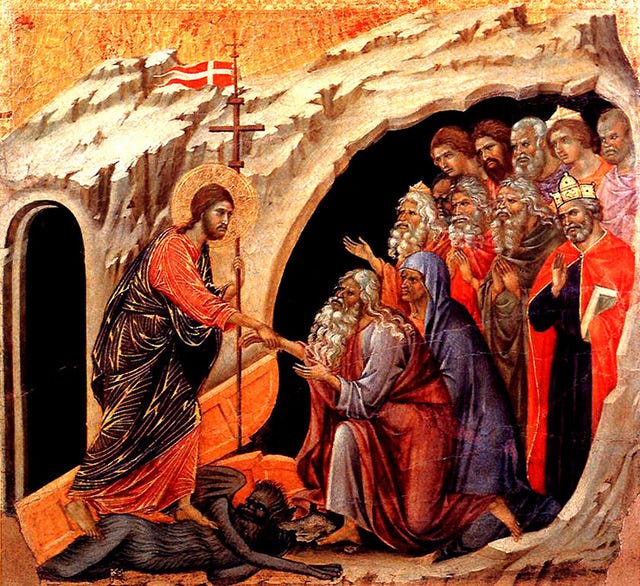
It is humbling. That humans are naturally oriented towards the truth but ultimately need Christ to bridge the final gap between God and man. That we simply cannot do it alone. Yet it is also hopeful insofar as Christ himself enters Hades and takes with him all those who awaited him. An end which exceeded any promise made by the Gods of Greek mythology. An end which is the life of God Himself.
Perhaps Christ’s resurrection is the true end of the Odyssey. One not shown on the screen. Christ breaking into the underworld, reclaiming the lost men, body and soul. Homer did not know of this as he spoke the last poems. For he too was waiting. In the luminous darkness before Christ’s revelation. Though now is united in perfect Love at his Odyssey’s end.
“Honey, Louis just dropped another theological masterpiece.” This is heat Louis 🔥